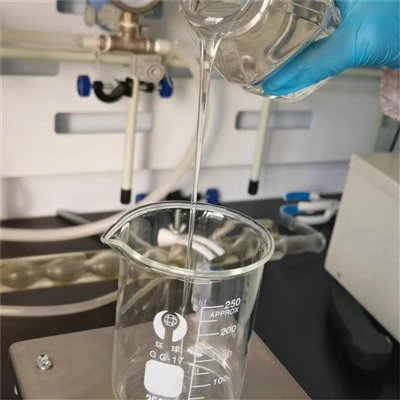
Choose silicone oils with higher molecular weight or specialized structures.
This is the most fundamental solution. The volatility of low-hydrogen silicone oils is closely related to their molecular weight and molecular structure.
Increasing molecular weight: While meeting application requirements, choose a hydrogen silicone oil with a higher molecular weight and slightly higher viscosity. A higher molecular weight means stronger intermolecular forces, requiring more energy to escape from the system, significantly reducing the volatility.
Choose branched or long-chain silicone oils: Compared to linear structures, branched silicone oils or modified silicone oils with the introduction of partially long-chain alkyl groups have lower vapor pressures, better stability at high temperatures, and significantly reduced volatility.
Adding a high-temperature volatility inhibitor or high-boiling-point solvent
Physically suppress volatilization through formulation adjustments.
Introducing a high-boiling-point carrier: Adding a small amount of an extremely high-boiling-point solvent or silicone oil (such as certain high-boiling-point organic esters or phenyl silicone oil) can act as a "barrier," raising the boiling point of the mixture and thereby reducing the volatilization of the low-hydrogen silicone oil. It is important to ensure that the additive does not react adversely with the Si-H bonds of the hydrogen-containing silicone oil.
Using fumed silica: Where permitted, add hydrophobic-treated fumed silica. It forms a three-dimensional network structure that physically "anchors" the silicone oil molecules to a certain extent, hindering their migration to the surface and volatilization.
Optimize process conditions and application environment
Slow down volatilization by controlling the external environment.
Lower processing temperature: While meeting curing or reaction requirements, lower the processing temperature as much as possible. Even a small temperature reduction can exponentially reduce volatilization losses. Evaluate whether increasing the heating time can achieve the same effect.
Shorten high-temperature exposure time: Optimize the process flow to reduce the time the material spends in the high-temperature environment. For example, adopt a process that rapidly heats up and cools quickly after the reaction is complete.
Improve equipment: If heating is performed in a closed vessel or reactor, consider applying a slight negative pressure or using an inert gas (such as nitrogen) as a protective blanket. Nitrogen not only removes oxygen, reducing oxidative side reactions, but also removes volatiles. More importantly, it reduces the partial pressure of volatiles, thereby controlling the volatilization rate to a certain extent. For open systems, consider using coating or dispensing equipment with a cooling element.
Pre-emulsify or prepare an emulsion
For certain applications (such as textile finishing), pre-emulsifying low-hydrogen silicone oil into an oil-in-water (O/W) emulsion is an excellent choice.
Water acts as a protective layer: The aqueous phase in the emulsion evaporates during the initial drying process, absorbing a significant amount of heat and effectively lowering the temperature experienced by the silicone oil itself. Once the water evaporates, the silicone oil forms a film or crosslinks at a lower temperature, significantly avoiding the risk of direct evaporation at high temperatures.
Improving safety: Emulsification also eliminates the flammability risk associated with direct use of low-hydrogen silicone oil.
To address the high-temperature volatilization issue of low-hydrogen silicone oil, the preferred solution is to switch to a higher molecular weight or specialized structured silicone oil. If raw material replacement is not possible, process optimization (cooling, shortening processing time) and the use of an emulsion system should be prioritized. This, combined with formulation adjustments such as adding high-boiling-point solvents, can effectively suppress volatilization and ensure product quality and production efficiency through a multi-pronged approach. Close communication with your silicone oil supplier is recommended; they can often provide the most suitable low-volatility products and technical support for specific applications.